
You are not behind, but you do need to using AI in your enterprise. Here’s how to do it.
I talk to CEO’s in distribution and manufacturing everyday. In this article I’m going to share with you what we are helping them with.
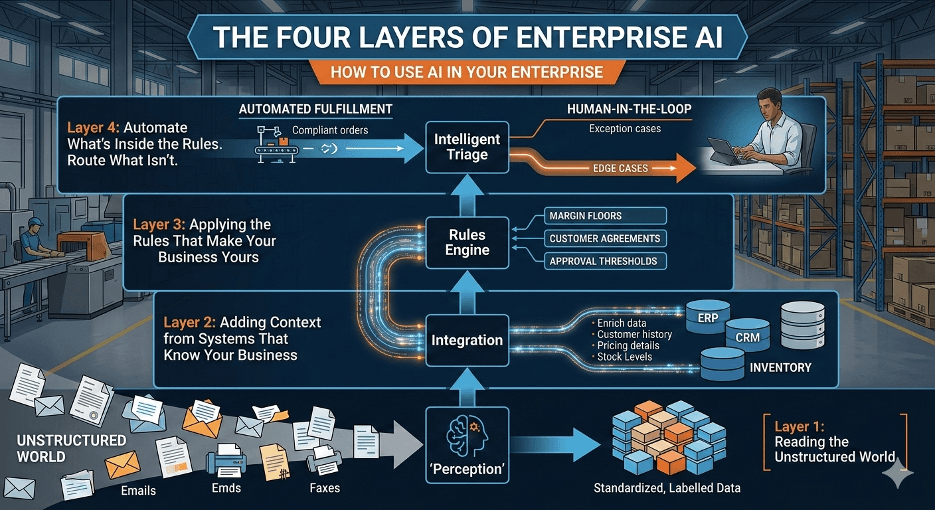
There are Four Layers of Enterprise AI in a successful, high ROI enterprise implementation. AI creates durable operational value inside a business as an integrated system that reads your world, understands your context, respects your rules, and acts on your behalf (sometimes).
AI hype will tell you that there is an agent that can run your business, transact on your behalf, predict the future, on and on and on. An enterprise AI implementation that will improve how a business operates, has four layers and no hype.
Layer 1: Reading the Unstructured World
The first layer is perception. Before AI can do anything useful inside a business, it has to be able to read the inputs and in most businesses those inputs are overwhelmingly unstructured.
Think about what flows into a manufacturer or distributor on any given day. Emails from customers requesting quotes, placing orders, asking about availability. Purchase orders attached as PDFs with fifteen different formatting conventions. Spreadsheets with product numbers in column headers, or in row labels, or embedded in a subject line. Faxes that have been scanned, rotated, and re-saved. Messages that say “I need 400 of the same thing I ordered last March, but blue.”
None of that is a structured database record. None of it arrives pre-labeled and ready for a system to consume. And the employees handling it today are spending enormous portions of their day doing nothing but reading and transcribing, converting the free-form, inconsistently formatted world into something the business system can understand.
This is where AI earns its first dollar of enterprise value; by reliably reading, at scale, the unstructured inputs that pour into a business every day, and converting them into structured, machine readable data.
The right question to ask at this layer is “what is my business receiving every day that a person is currently reading and re-entering by hand?” That is your Layer 1 opportunity. And for most manufacturers and distributors, it is substantial.
Layer 2: Adding Context from the Systems That Know Your Business
Reading an inbound order accurately is necessary but not sufficient. Because a product number and a quantity don’t tell you whether this customer has a negotiated price. Whether that part is in stock. Whether this account is on credit hold. Whether the requested ship date is achievable given current lead times. Whether this is a first-time buyer or a relationship that goes back fifteen years.
That context is already in your ERP, your CRM, your pricing engine, your inventory platform. It has been accumulated over years of transactions, contracts, and customer interactions. It is the institutional knowledge of your business, encoded in data.
Layer 2 is the integration layer. It is where the AI system reaches into your existing systems of record and pulls the context it needs to turn a raw, parsed request into a fully informed decision.
This is the layer that separates enterprise AI from consumer AI. A general-purpose AI tool has no idea what your contract terms with a specific account say. It doesn’t know that a particular SKU has a 12-week lead time right now, or that a customer in a specific region gets a different price list. That context is yours. It is specific to your business and your relationships. And it is the reason why AI that is connected to your systems is categorically more powerful than AI that is not.
The practical implication is that enterprise AI is not a standalone product you plug in. It is an integration. The value it delivers is proportional to the depth of its connection to the systems that contain your business context. Companies that approach AI as a separate tool, running in parallel to their operations rather than through them, will consistently underperform companies that build AI into the data flows and systems business.
Layer 3: Applying the Rules That Make Your Business Yours
Context-enriched data can power a decision. But which decision it should power depends entirely on the unique rules of your business. They are the accumulated result of your strategy, your relationships, your risk tolerance, and your operational constraints.
A 30-year distributor of industrial components has margin floors it cannot breach. Customer agreements that guarantee specific pricing. MAP policies negotiated with manufacturers. Credit terms that vary by account. Approval thresholds that require a sales manager’s sign-off above a certain order value. Inventory allocation priorities during shortage conditions.
None of that is something an AI model knows. None of it should be hardcoded in a way that requires a developer to change when your strategy shifts. It should be configurable, auditable, and owned by the business.
Layer 3 is the rules layer. It is where your business logic is encoded as explicit, testable, governable policy and where that policy wraps around the AI’s outputs to ensure that every automated decision is bounded by what your business has decided is acceptable.
This is the layer that makes AI safe to deploy at scale in an enterprise context. Without it, AI operates in a vacuum of its own probabilistic judgment, and the results are unpredictable in the ways that matter most to regulated, relationship-driven, margin-sensitive businesses. With it, AI operates as a disciplined enforcer of your strategy.
The companies that will lead in enterprise AI over the next decade are the ones that have invested in encoding their operational intelligence as explicit, governed rules and built AI systems that execute within them.
Layer 4: Automate What’s Inside the Rules. Route What Isn’t.
The final layer is where value is delivered and where most thinking about AI goes wrong.
The instinct, when people imagine AI automation, is to picture a system that handles everything. Full automation. In most enterprise contexts, it is the wrong goal. Because the edge cases never stop coming, and a system that can’t handle edge cases gracefully creates more chaos than it resolves.
The right goal is not full automation. It is intelligent triage.
When an inbound order arrives, is parsed accurately, matches a known customer, references in-stock product at a valid price, and satisfies every configured rule, that order should be fulfilled automatically, completely, without a human touching it. The system has enough information and enough context to do that with accuracy.
But when an order references a part number that doesn’t exist in the system. When a customer requests a price that falls below a margin floor. When the requested quantity would trigger an unusual allocation decision. When something about the request is ambiguous, incomplete, or outside the defined parameters, that case should not be handled automatically. It should be routed to a person, immediately, with the full context of what was received, what was parsed, what was checked, and exactly why the automation stopped.
This is the human-in-the-loop not as a fallback or a limitation, but as a designed feature of a well-built system. The human isn’t cleaning up after a failed automation. They are handling the cases that genuinely require judgment, equipped with better information than they would have had without the AI, and freed from the volume of routine cases the AI has already handled.
The businesses that get this layer right will discover something important: their people become more effective, not less relevant. The work that reaches a human has been pre-qualified and pre-enriched. The decisions they make are higher-value. The exception becomes the interesting problem, not the thousandth version of the same data entry task.
What This Means for Where to Start
Here is the practical takeaway for any CEO or operations leader reading this.
You do not need to wait for a perfect AI strategy. You do not need to hire a chief AI officer or commission a multi-year transformation program. You need to identify one operational workflow in your business that has all four of these layers present and build it.
Find the workflow where unstructured inputs arrive every day. Where context from your existing systems would enable better, faster decisions. Where your business rules are clear enough to encode. And where the volume of routine cases is high enough that routing them to automation would meaningfully free your team.
The companies that will look back in five years and feel good about where they are on AI are not the ones that made the biggest bets. They are the ones that built the first complete layer stack and learned from it. Then built the next one.
The technology to build this exists right now. The only thing most companies are waiting on is the decision to start.