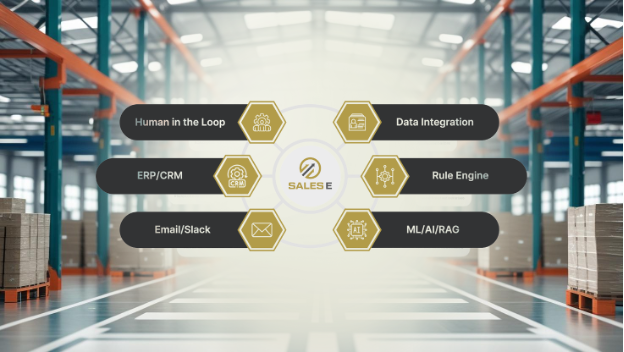
In defense and government operations, where decisions can mean life or death, AI cannot operate unchecked. Automation without oversight risks mission failure, ethical lapses, and loss of public trust. That’s why SalesE’s Rule Engine architecture is the prudent prerequisite for deploying AI responsibly in high-stakes environments.
Why AI Alone Isn’t Enough
AI’s appeal is undeniable with speed, adaptability, and predictive insight. But history shows its perils:
- In 2003, a semi-automated Patriot missile system misidentified targets, resulting in tragic consequences despite having a human-override mechanism (Brookings).
- Bias-induced targeting errors, like misclassifying civilians as combatants, are not hypothetical. Defense systems have mistakenly identified non-combatants due to flawed or incomplete AI training (RealClearDefense, ICRC).
- AI can accelerate the “kill chain” but may also shorten human reaction time to validate decisions, amplifying civilian risk (Utrecht University, Defense One).
These risks make clear: AI must operate within strict, transparent guardrails.
How the Rule Engine Architecture Fixes AI’s Blind Spots
The Hybrid Workflow: AI + Rules (Rules Before Reasoning)
- AI Recommendation
AI systems generate probabilistic outputs whether simulating policy outcomes or recommending engagement pathways. - Rule Enforcement Layer
The SalesE Rule Engine intercepts outputs and applies deterministic logic based on rules of engagement, legal norms, or policy directives. It can also compare logic-based answer to AI-based answer or model to model matching to confirm accuracy prior to decision making. - Outcomes
- Allow: Aligns with policy and mission parameters.
- Modify: Adjusts recommendations to meet constraints.
- Escalate: Flags uncertain or high-risk outputs for human review.
- Deny: Blocks outputs that violate rules.
Every decision is logged—who, what, when, and why—ensuring traceability.
Real-World Use Cases
- Course of Action (COA) Filtering: AI-generated recommendations are blocked if they conflict with rules of engagement, such as civilian protection thresholds.
- Autonomous Drones: Prevents lethal actions outside approved zones; unauthorized commands are modified or held for human decision.
- Policy Simulations: Prevents models from proposing outcomes that breach ethical boundaries, such as inequitable resource allocation.
- AI Procurement and Cybersecurity: Ensures outputs remain aligned with regulatory frameworks and do not trigger non-compliant behavior.
Implementation: Getting Started
Step 1 – Identify High-Risk AI Outputs
Target key decision points such as engagement recommendations or simulation results.
Step 2 – Codify Governance Logic
Translate rules of engagement, legal mandates, and ethical limits into the Rule Engine’s logic.
Step 3 – Layer Rule Engine, AI and routing
Deploy as an integrated middleware layer between existing AI systems and operational channels, or as a unified AI-and-Rule-Engine platform that serves as the primary, guardrail-enabled interface to those channels. Define escalation path and destination for corner cases requiring a decision maker in the loop.
Step 4 – Pilot and Validate
Simulate real scenarios to test rule effectiveness and refine thresholds with human oversight.
Step 5 – Scale and Govern
Enable rule updates through secure workflows with administrative controls and clear audit trails.
Why This Matters
Public trust in AI is dwindling and that poses a national security issue (Defense One). SalesE’s approach of Rules Before Reasoning restores accountability, enabling agencies to deploy AI without sacrificing human oversight or mission integrity.
Contact the SalesE Federal Team
Ready to move forward? Reach out to the SalesE Federal Team to explore how a rules-first architecture can anchor your AI deployments in control, transparency, and trust.